
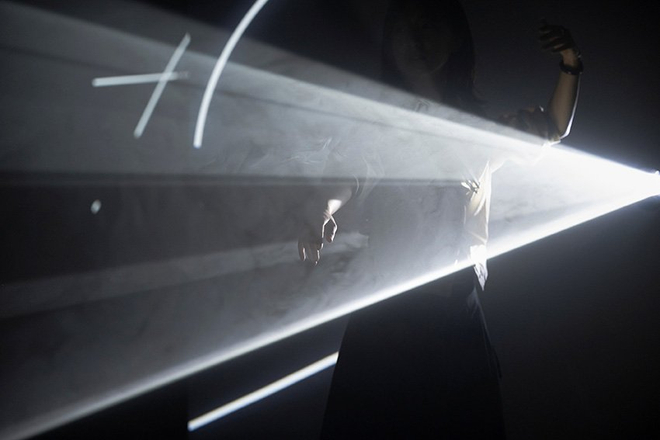
Anthony McCall: Solid Light, presented in collaboration with Tate, explores the intersection of cinema, sculpture and drawing through large-scale, immersive installations. A pioneering figure in experimental film and installation art, McCall transforms projected light into sculptural form, creating slowly evolving volumes of light that visitors can walk through, offering a fully captivating experience. These “solid light” works challenge the boundaries of traditional media, offering a spatial encounter that invites active participation and reflection.
McCall began his career in the 1970s immersed in London’s independent film scene and shortly after relocated to New York, where he developed his renowned solid light works. Among the works featured in the exhibition is his seminal piece, Line Describing a Cone (1973), that redefines the cinematic experience by shifting focus from the screen to the projector itself. The result is a drawn form made from light, one that unfolds over time and requires the viewer’s physical presence to fully engage with it.
This exhibition features McCall’s solid light installations, accompanied by rare archival materials, photographs and early performance films such as Landscape for Fire (1972). These foundational works highlight McCall’s exploration of the tension between the precise logic of geometric arrangements and the unpredictable forces of nature, establishing themes that would inform much of his later practice. "Visitors are an important part of these works. Anthony sees visitors as being important collaborators and performers; when you are looking at his works you are also looking at people interacting with them like performers, so the exhibition veers into this realm of performance," said Andrew de Brun, co-curator of the exhibition at Tate Modern.
In works like Doubling Back (2003) and Split-Second Mirror (2018), both featured in the exhibition, McCall revisits these themes with new technologies, using digital projection and haze to deepen the interactive and architectural qualities of his work. Over the course of his career, McCall has continued to explore how the simplest elements—light, form, and movement—can produce complex, immersive experiences that surpass conventional boundaries.
Today, McCall’s solid light works have influenced countless artists at the intersection of film, installation and immersive art, cementing his place as a visionary in contemporary visual culture.